Tag Archives: museums

The Estonian Meremuseum

Standard
The Estonian Meremuseum

Friday, 07-June-2024


Ohh many I got up to a lot of adventures on Friday.

I was excited to be in Estonia – Like I mentioned back in the beginning post, the Baltic was a whole new world for me to be adventuring through; a culture I really hadn’t had any exposure to in my past, an open slate of discovery.

I absolutely planned on making the most of my time here.


On the ferry from Helsinki to Tallinn, I’d met two folks – a lady named Magdelinna from Austria, and a guy named Steven from Canada. No, not my Stepdad (who’s also a guy named Stephen from Canada), though the symmetry of the name was definitely interesting. We met organically as we were all lounging on the roof deck of the liner, and I got quite a few good tips from both for various places around Europe. Most applicably to the conversation right now, Steve recommended that I stop into the Estonian Meremuseum while I was in Tallinn.

I hadn’t heard of it before, but a recommendation is as good a reason as any to explore. After the Kumu art museum, I made my way through the city, along some beautiful boulivards and through amazing gardens, to what looked like the villain’s lair from a James Bond movie.

(Quick note – I originally thought this building was an old submarine pen, but I was a bit mistaken. It was actually a sea-plane hangar! Both more unique and less exciting at the same time, somehow. Still staggeringly beautiful, though!)


After I got over my initial awe at the sheer expanse that I found myself in, I started into the joy of reading placards and looking at cool things. There were so many of both – and let me just take a moment to appreciate how awesome all these countries are about multi-language placards. Everything was in both Estonian and English, and I am so thankful for that fact. I saw quite a few German tourists having to use google translate on all the placards, and that just seemed so exhausting… being able to just read (even with the infrequent “unique” English grammar) has been such a blessing for me.

I wandered, learned about ice skiffs and buoys, and saw histories of ships trading hands and transferring between countries. I learned about seaplanes, torpedoes, and mines, and even about rescues on the high seas.


My biggest takeaway, as interesting as this is, was just how staggeringly overwhelming the United States is. You never hear about the United States selling the flagship of its Navy to another country after it’s finished service… and I can’t conceive of the United States Navy buying a ship from another country to serve as the lynchpin of it’s defense fleet. Even the idea of a frigate being used as the flagship is… strange, to say the least.

It was a good reminder of the sheer magnitude of the US manufacturing base, and the amount of material we dedicate to our military. I know all those details, logically, but having them brought front-and-center like this helped make the sterile facts and figures a bit more real and organic.


After finishing out the inside of the Seaplane Hanger, I headed outside to the docks – where there were quite a few retired patrol boats and cutters set up as small museum ships!

Most of them were simply available to be viewed – boarded, but there weren’t really any stories to be told by placards, and no open hatches allowed for exploration of the below decks.

One, though, the Suur Tõll, was a full floating museum ship. A steam-powered icebreaker, refurbished repeatedly over its lifespan, I was able to clamber aboard and drop down into the bowels of the ship through tiny hatchways and into dank engine compartments. It reminded me of all the times I’ve worked in machine shops – oil and metal in the air, and this really interesting scent that I can’t really describe. Maybe oil and diesel, mixed with sweat and metal chips?


Either way, it was really interesting! The placards were spinning triangles, allowing for Estonian / Russian / English information, telling the story of the ships life… starting as a coal-fired steamer, to its retrofit into oil-power, to its final rest as a museum ship.

Definitely worth the visit – and I didn’t even get seasick of claustrophobic, even while below the waterline in a cramped engine room! Yay Ben!
Christmas in Italy – The Galileo museum

Standard
Christmas in Italy – The Galileo museum

In keeping with the tradition of adventure, Sarah and I went on a big trip for Christmas and New Years!

This year, we met up with Sarah’s family in Italy, traveling to Rome and Florence; not quite a perfect midpoint for everyone, but it was close enough. And, also, you know. Rome. Florence. Amazing!

Please forgive me for some of these being a bit out of order… the posts are organized somewhat chronologically… but also organized by theme and location.  Some may not be exactly in chronological order, so for reference please see the initial summary post, which has a complete day-by-day, blow-by-blow account of the adventure.


Wednesday, 03-Jan-2018

While we were preparing for this trip, I poked around a bit online for places in Florence to look at. I knew that it was the home of the renaissance, and that countless groundbreaking discoveries were made here. In trying to narrow down the scope of what to look at, I came up with two – Leonardo DaVinci, and Galileo Galilei.


The Leonardo DaVinci museum, we accidentally stumbled into on our adventures earlier in the week. But the Galileo museum was a targeted adventure… partially because the week was ending, and partially because it was literally directly across the street from our apartment. Convenient, right?

I’ll be honest though – by the time we made it to the museum, I was pretty well saturated. This was our last day in Florence, and we’d been bouncing all over the place getting in a few last adventures before the end of the day. We’d seen so many beautiful places and views that I was struggling to keep focus and stay sane & aware.

With that in mind, this museum was still amazing.

Obviously, there were telescopes, but there was also so much more. The term “renaissance man” truly applies to Galileo; there were experimental items of his concerning electricity, magnetism, medicine, and of course astronomy. There was a massive amount of information about everything, and an honestly staggering number of masterly crafted showcase devices.

It was a really neat concept, honestly – these ornate machines designed purely to demonstrate a single scientific principle, such as induced magnetism or acceleration, or rotational acceleration. I’ll be honest… I think that if science classes used these machines in their demos, we’d have a radically different society. But these weren’t used in classrooms, we learned that they were used to demonstrate research to the nobles and elites of the city, who were funding the scientists doing the work. An interesting deliverable, to be sure.

The nobles would then throw “Science Salons” for all their friends, demonstrating whichever new principle had been discovered recently. It’s kind of neat to imagine, a whole group of victorian movers and shakers, all being astounded by the sort of electric displays that I grew up with in the Museum of Science, back in Boston.

Not all of the displays were purely conceptual though. Some were downright creepy, though undeniably necessary to modern medicine. We saw an entire room full of anatomical sculptures describing pregnancy, its possible complications, and how the doctors and midwives would treat those complications. Very interesting… but the way that they were sculpted definitely went over the line between anatomical and creepy.

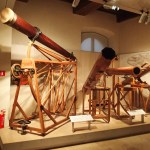
And of course, there were telescopes. Galileo didn’t just have his one telescope, of course, but there was one room with dozens of telescopes used by countless astronomers. They were gorgeous, just as ornate as the demonstration machines, but obviously well worn from use. Some were the small hand-held ones that you think of when you picture Galileo, but there were also huge free-standing telescopes more reminiscent of modern observatories.

Christmas in Italy – Exploring Ostia Antica

Standard
Christmas in Italy – Exploring Ostia Antica

In keeping with the tradition of adventure, Sarah and I went on a big trip for Christmas and New Years!

This year, we met up with Sarah’s family in Italy, traveling to Rome and Florence; not quite a perfect midpoint for everyone, but it was close enough. And, also, you know. Rome. Florence. Amazing!

Please forgive me for some of these being a bit out of order… the posts are organized somewhat chronologically… but also organized by theme and location.  Some may not be exactly in chronological order, so for reference please see the initial summary post, which has a complete day-by-day, blow-by-blow account of the adventure.


Wednesday, 27-Dec-2017

One of the targets that we’d locked in before flying to Italy was a historic site called Ostia Antica – I hadn’t heard of it before, but a quick search told me that it was a set of ruins from a port city that fed Rome, and acted as a barracks for troops. Interesting, and since it was a train ride outside of Rome it would be a great chance to see a bit of the countryside.

The day itself started kind of roughly – I don’t really know why, but for some reason I had a heck of a time mobilizing myself and getting moving. Just a high gravity day, I guess… but once I drank some coffee and ate a coronetti I was feeling right as rain. Which was critically important. Since it was, in fact, raining outside.

Our first order of business was to get umbrellas. Greta and I took the lead on that one, which was honestly quite an easy task, since there were umbrella salesmen on literally every street corner as soon as we left the apartment. We ambushed one (or were ambushed… I’m honestly not sure which) (Ed Note: Greta and Ben were ambushed) and started the time honored tradition of haggling.

Our case was made a little weaker due to the fact that we were standing in pouring rain, but we still negotiated the guy down to 50% of his asking price. He wanted 40 Euro, we paid 20 for four umbrellas. Not bad, right?


Wrong. We still got swindled.

See, what we didn’t know is that these umbrellas came from “Jim’s bad umbrella emporium”, or some equally disreputable manufacturer. We learned this when, not 5 minutes after paying, the first of the four umbrellas inverted and collapsed.

I won’t reference these umbrellas again, but just keep in mind that Sarah and I were the only ones with full mountaineering rain gear, and the rain was STILL getting through our gear. The rest of the group were contending with umbrellas that were… less than reliable. As the day went on we kept a casualty count of the umbrellas. The longest surviving one lasted until we got back to Rome, but not all the way to our door.

Anyways, moving on from umbrellas.

Our train ride was lovely, and a bit eye opening. We started out at the station under the Spanish Steps, and quickly left Rome proper. Once we were past the main city, we got to see a bit more of the real version of Italy; Small towns, interspersed with empty buildings and abandoned apartment complexes. It was a stark contrast to the opulence of Rome and the Vatican, and reminded us that Italy itself is far more than just the main cities that we were staying in.

We de-trained in Ostia Antica, braving the rain once again. It was a short walk to the main historic site, but once we were there…

Ostia Antica is basically a huge open-air excavation of ancient Roman ruins. I mean that – there are main paths, but almost nothing is off limits except for the active excavation areas. Walking along dirt paths, you can nudge the mud with your boots and see beautiful mosiacs still buried underneath. The buildings aren’t restored, and very few of them even have placards… It’s honestly as if we just teleported into a video game, exploring undiscovered ruins.

Since the area was so vast and disconnected, the group splintered off pretty quickly – Sarah and I headed deeper into the uncontrolled ruins, while Bill and Greta followed the main path and Henry and Leah headed toward the museum.


It was beautiful, and we quickly got lost in exploring.

I found an old building choked with vines, that we could crawl into and explore. Sarah found the main amphitheater, and walked me through how it compared to present-day theater setups. We found giant mosaics, old fountains, and even an ancient public bathroom (no, we didn’t use it). It was amazing, and we quickly became lost in the exploration.

Thankfully, Bill and Greta pulled us back to reality with a call to lunch; we hadn’t quite noticed, but the hours had flown by, and we were a bit overdue to meet back with the group. We all met up for lunch, then explored the on-site museum – basically where they took all of the exceptionally interesting finds as the ongoing excavations uncovered them. The museum was quite small, for the scale of the area, but definitely worth seeing.

The path home was a wet one, but we persevered somehow. The rain had been getting worse as the day went on, and actually turned to hail by the end… but thankfully by that point we only had a few hundred yards to go before we hit the shelter of the train station, so it was only mildly unpleasant… and honestly just added to the adventurous feeling of exploring ancient ruins.


The last adventure of the day was dinner – It was Sarah and my’s turn to cook, so we settled down on the train and concocted a rather brilliant meal plan for the evening, based on what we had left in the kitchen. Not to toot our own horn, but… it was glorious. We based it on the standard appetizer, pasta, main course list from a traditional Italian meal, with a small twist – we combined the pasta and the main, and had two conflicting dishes. One was heavy with a red sauce, and the other was light with a butter sauce. I like to think that they contrasted well.

Appetizer, to tide everyone over: Bread & dipping oil

Salad course: spinach salad with green beans and seared steak strips

Main Course #1: Papardelle with red sauce, with sausage and mushrooms

Main Course #2: Orecchiette with prosciutto and butter sauce

Wine: A light Red, if I recall correctly